AI is cheap
in a demo.
Expensive without control.
AI is already entering your business through tabs, tools, automations, and team experiments. Telars helps you choose the first workflow worth building, define the controls around it, and train your team to operate it.
Every AI vendor
is selling access.
Very few are
selling control.
That's the gap
Telars was built for.
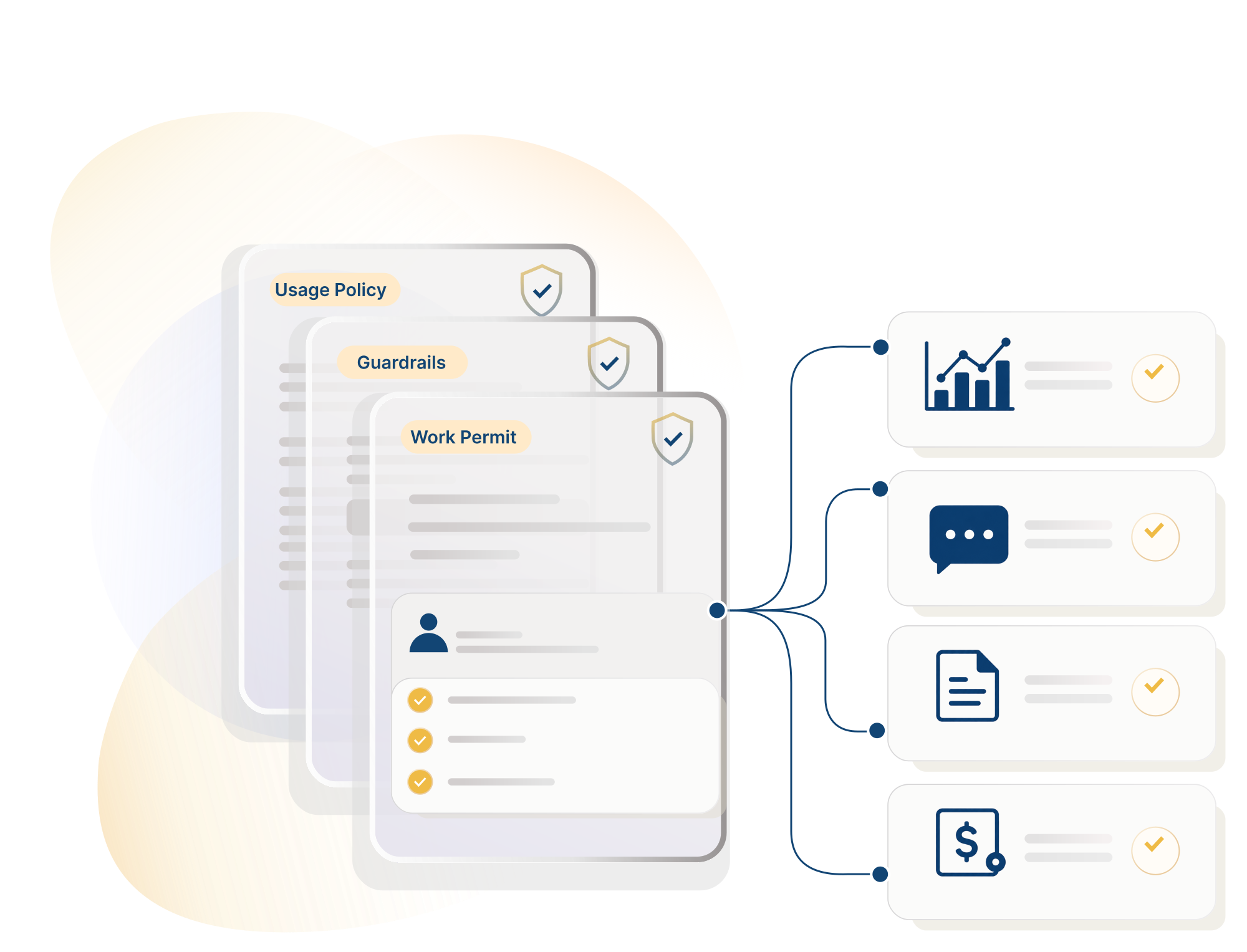
Most businesses already have AI in the workflow. ChatGPT tabs. Copilot subscriptions. Zapier automations. Employee experiments. Access was never the problem.
The problem is visibility: what is AI actually doing, what data can it touch, what does it cost to run, and who is accountable when it gets it wrong?
Responsibility without visibility is the new default, and most leaders do not notice the cost until something matters.
That gap is: one useful workflow, one defined budget, one human review path, one trained owner.
What can become
a controlled AI workflow?
Recurring, data-heavy work that currently depends on a person, and does not need to stay that way.
A good first AI workflow is recurring, data-heavy, reviewable, and measurable.
Not a chatbot. Not a co-pilot. A real process with a defined job, a data boundary, a cost limit, and a human who owns the result.The Five
Controls
Every AI workflow we build answers five questions. Without all five, you do not have a controlled workflow. You have an experiment. Select any control to see what Telars defines.
Job Control
The most overlooked question in AI adoption. A workflow without a defined job is an experiment with an unknown outcome. Job Control forces clarity: what task, with what boundaries, producing what output, and what happens when AI is uncertain.
What Telars defines
The Control Map:
five steps, one build-ready blueprint.
The Control Map is the first paid step. It defines everything before anything is built, then gives your team a blueprint you can build with Telars or take in-house.
Built by a systems
architect. Not an
AI reseller.
Telars is led by a hands-on systems architect who works directly with AI, code, data, workflows, agents, automation, and business process design. The role is not to sell a tool. The role is to understand your work, design the control layer, and train your team to own the result.
We use AI aggressively behind the scenes for research, architecture, prototyping, and documentation. But human judgment owns the architecture, the quality, the training, and the handoff. You work with a person who is accountable for the output.
One controlled
workflow at a time.
Every build includes training. Every handoff includes documentation. Your team operates it, not us.
Before we build anything, we define what AI is allowed to do. The result is not a strategy deck. It is a build-ready control blueprint. We identify one workflow worth building and answer all five control questions with an implementation-ready plan.
We build one controlled AI workflow with your team: model routing, budget rules, human review gates, error handling, and documentation. Then we train your people to run it, review it, and improve it.
Bring the technical problem nobody has time to solve. We map the problem, define the path, identify the tools and data requirements, surface the risks, and deliver a next-prototype plan your team can act on immediately.
Ongoing AI systems architecture for teams that want to keep expanding safely. Architecture support, workflow reviews, cost monitoring, model and tool guidance, team enablement, and roadmap planning. A fractional AI systems architect, not a helpdesk.
AI speed.
Human judgment.
Team ownership.
We use AI aggressively behind the scenes for research, architecture, documentation, and rapid prototyping. But human judgment owns the architecture, the quality, the training, and the handoff.
You work directly with a systems architect. Not a junior implementer. Not a black box. Someone who understands AI, code, data, workflows, agents, and business process design, and is personally accountable for the result.
AI is already in your business. In the tabs your team has open. In the automations someone set up last quarter. In the subscriptions on the card.
The question is not whether to use it.
The question is whether you are the one who decides what it does.
Bring one recurring process. We will tell you if it is worth turning into a controlled AI workflow.
Start with one workflow.
Send the process, the team, and the current pain. The first conversation starts with context, not a blank call. You can also book directly.